
30 September 2026
Car Parking Tensile Structure vs Metal Shed — Which Is Better for Maharashtra Homes & Societies?
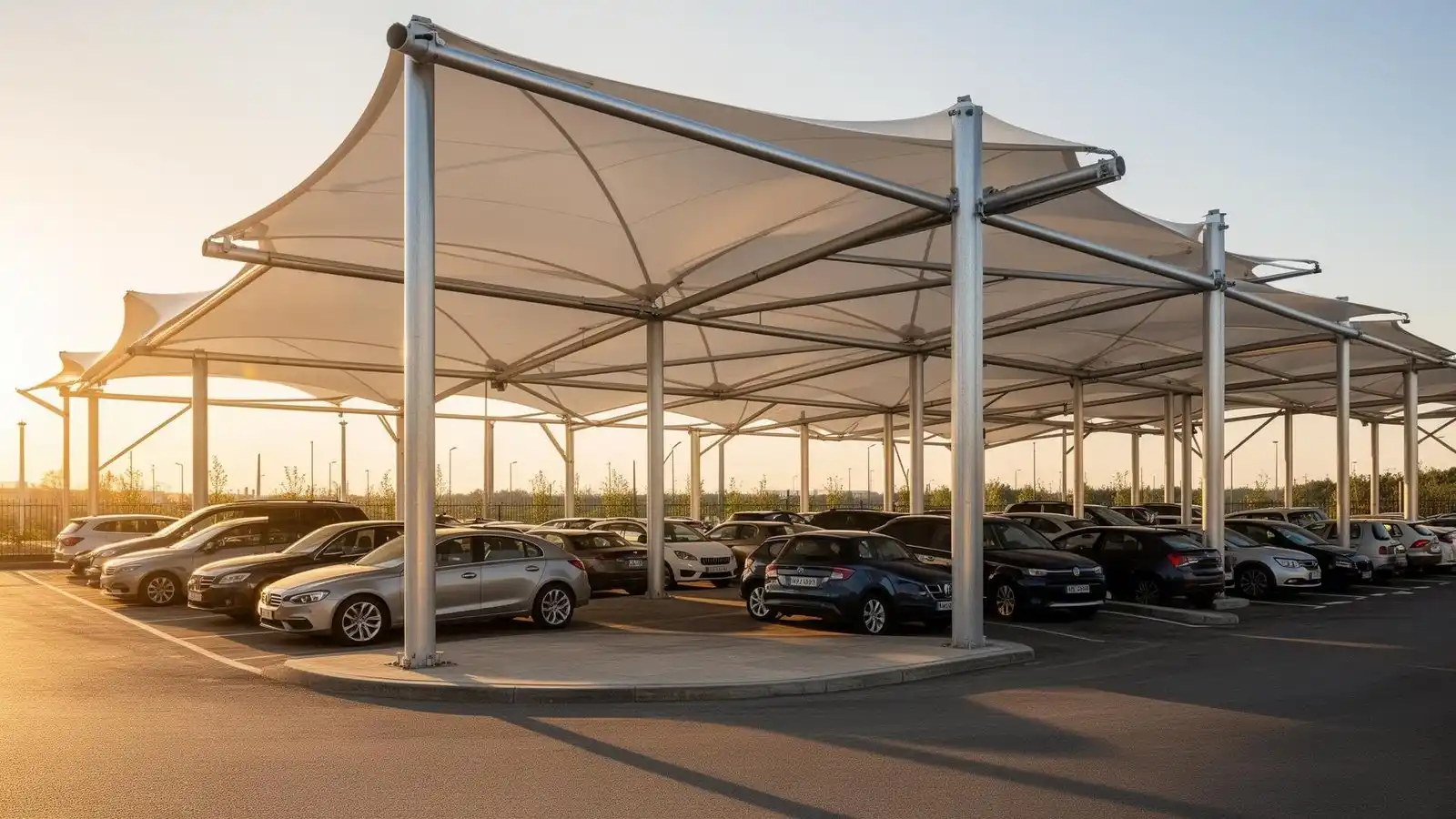
When someone in Latur, Nanded or Aurangabad decides to cover their car parking, two options come up almost every time — a tensile fabric structure or a metal sheet shed. Both protect your vehicle. Both use steel frames. But they are not the same product, and choosing the wrong one costs you money over the next ten years.
This guide compares both options honestly, based on what actually happens to these structures in Maharashtra's climate.
The Core Difference
A metal shed uses galvanised iron or colour-coated steel sheets fixed to a rigid frame. The roofing material is hard, fixed and opaque.
A tensile structure uses high-strength PVC or PVDF fabric stretched under tension across a steel frame. The roofing material is flexible, engineered and semi-translucent.
That single difference — rigid sheet versus tensioned fabric — drives almost every other comparison below.
Cost Comparison: First Installation
| Structure Type | Metal Shed (₹/sq ft) | Tensile Structure (₹/sq ft) | |---|---|---| | Single car (150–250 sq ft) | ₹180 – ₹260 | ₹280 – ₹380 | | Multi-car (500–1,500 sq ft) | ₹160 – ₹230 | ₹250 – ₹340 | | Large society parking (2,000+ sq ft) | ₹140 – ₹200 | ₹220 – ₹300 |
Metal sheds cost less upfront — that is a fact. For a tight first-time budget, a metal shed is a reasonable starting point. But upfront cost is only part of the equation.
10-Year Total Cost of Ownership
This is where the comparison shifts.
A metal sheet roof in Maharashtra degrades faster than most people expect. The combination of summer heat above 44°C, heavy monsoon rainfall and the humidity of Marathwada causes colour-coated sheets to blister, fade and rust at the cut edges within 4–6 years. By year 7–8, most metal sheds in this region need either full re-sheeting or replacement. That is a second installation cost.
A PVC tensile fabric, properly installed with a 650 GSM or higher membrane, lasts 8–12 years in the same conditions without re-sheeting. PVDF fabric lasts 15–20 years. There is no rusting, no blistering and no colour fade.
| Factor | Metal Shed | Tensile Structure (PVC) | |---|---|---| | First installation cost | Lower | Moderate | | Lifespan in Maharashtra | 6–9 years | 8–12 years | | Re-sheeting / replacement cost | ₹120–180/sq ft at year 7 | Nil within warranty period | | 10-year total spend (approx.) | Higher due to replacement | Lower overall | | Appearance after 5 years | Faded, rusty edges | Unchanged |
Heat Performance — The Most Important Factor in Marathwada
Latur recorded temperatures above 42°C on over 45 days in 2025. Osmanabad and Nanded follow similar patterns. This makes heat performance under the parking structure a real concern — both for vehicle paint and for anyone who uses the parking area during the day.
Metal sheets absorb solar radiation and radiate it downward. The temperature directly under a metal sheet roof on a 43°C afternoon in Latur regularly reaches 48–52°C. Steering wheels, dashboards and car seats heat to a level that causes discomfort and accelerates interior wear.
Tensile fabric — particularly PVDF-coated material — reflects between 70% and 85% of solar radiation depending on the colour and grade. The temperature under a good tensile structure on the same 43°C afternoon stays between 31–34°C. That is not an estimate — it is a measurable outcome from the reflectivity and ventilation design of the tensioned membrane.
For a housing society where residents walk to their cars multiple times a day, this difference matters.
Appearance and Society Approval
This point is practical, not aesthetic vanity.
Housing societies and commercial complexes in Maharashtra increasingly have guidelines about what external structures look like. A rusting GI sheet shed attached to a modern apartment building often creates friction at society meetings. Flat-roofed metal sheds collect water and debris, require slope management and look dated within a few years.
Tensile structures are accepted — and often required — by builders, architects and housing society committees because they look finished. Conical and arch tensile designs in particular complement modern apartment buildings. Several housing societies in Latur and Aurangabad have specifically requested tensile structures during renovation of their parking areas because of this.
Maintenance Reality
Metal shed maintenance includes repainting or re-coating every 3–4 years to prevent rust progression, tightening of bolts and purlin connections after monsoon season, and eventual re-sheeting of the roof when sheets begin leaking at the laps.
Tensile structure maintenance includes re-tensioning of fabric if it loosens over time, cleaning of the membrane once or twice a year with mild detergent and water, and inspection of clamps and anchor bolts after heavy wind events.
Neither requires constant attention. But metal shed maintenance is costlier per cycle because it involves surface treatment, material and labour for re-coating. Tensile maintenance is largely a cleaning and tightening job.
When Metal Shed Is the Right Choice
There are situations where a metal shed makes more sense and it would be dishonest not to say so.
If the structure is inside a covered industrial compound where aesthetics are irrelevant and the parking area already has a primary roof above it, a basic metal shed under an existing canopy is perfectly adequate.
If the budget is genuinely below ₹40,000 for a single car space and the client accepts a shorter lifespan, a metal shed is a viable starting point.
If the structure will be used in a purely agricultural or utility context — a tractor parking area or an equipment yard — metal sheeting is standard and appropriate.
For everything else — residential homes, housing societies, commercial buildings, hospitals, schools, hotels — tensile structures deliver better value over any period beyond five years.
Which Is Better for Your Specific Situation?
You have a single home in Latur with one car: A tensile car parking shade at ₹55,000–₹75,000 fully installed will last you 10–12 years, keep your car significantly cooler, and look good against your house. This is the right choice.
You manage a housing society in Nanded with 20–40 car bays: A multi-bay tensile structure at ₹250–₹320 per sq ft is the correct solution. The lower per-unit cost at scale, the maintenance advantage and the appearance in a residential environment all point to tensile.
You are setting up a factory or warehouse parking in Osmanabad: If the area is already shaded or the priority is purely budget, metal can work. If the parking area is open-air and workers use it daily, tensile is still the better call on heat performance alone.
You want to install once and not think about it for 15 years: Go with PVDF-grade tensile. The upfront cost is higher but it is genuinely the last installation you will need within that window.
Frequently Asked Questions
Is a tensile car parking shed waterproof in Maharashtra's monsoon? Yes. PVC and PVDF tensile fabrics are 100% waterproof. The structure is designed with a slope or curvature that directs rainwater away from the parking area. Maharashtra's monsoon — including the heavier rainfall in Marathwada — is not a problem for a properly installed tensile structure. The frame is engineered for wind loads up to 120 km/h when built to IS 800 standards.
Does a tensile structure make more noise than a metal shed during rain? Tensile fabric absorbs rain impact rather than amplifying it. Metal sheets produce significant noise during heavy rain. If the parking area is adjacent to a bedroom or living space, tensile structures are noticeably quieter — an overlooked practical advantage in compact home plots.
Can I add more bays to a tensile structure later? Yes — this is one of the genuine advantages of tensile construction. The frame can be extended by adding columns and fabric panels. Metal sheds can also be extended but require matching the existing sheet profile, which is harder to do cleanly after a few years.
How long does installation take for a 4-car tensile parking structure? A standard 4-bay tensile car parking structure of approximately 800–1,000 sq ft takes 3–5 working days to install including the concrete anchor work for the columns.
Is a tensile car parking structure allowed by most housing societies? Yes — tensile structures are almost universally permitted by housing societies in Maharashtra because they are classified as temporary structures that do not affect the building's structural load. Metal sheds are also permitted but tensile structures are generally preferred by building committees for appearance reasons.
Where can I get a tensile car parking structure installed in Latur or nearby districts? M Fortune Engineering is based in Latur and covers all of Marathwada — Latur, Nanded, Osmanabad, Parbhani, Aurangabad and surrounding areas. We offer free site visits and provide a written quote with drawings within 48 hours.